

King Solomon once said that there’s nothing new under the sun. His were not the eyes of a small child. Nor could he have foreseen the ‘Great Southern Land’; ancient but ever new.
I was seven years old in the mid-1960s when our family prepared to up root; to leave ‘the Old Dart’ to set up a new life in Australia. The eldest of four siblings, I had little understanding of the adventure that lay before us. Indeed, I had only an embryonic understanding of the place of my birth – the land we would leave behind – knowledge that, in the years to come, I would learn ‘in absentia’ and from very far away.
I remember very little about the multiple flights that brought us safely from London to Adelaide. Only two things stand out: the trip seemed to take forever in an aging BOAC propjet and my poor mother had the indignity of spending the entire time smelling of vomit courtesy of my baby sister.
I recall clearly, however, our first hours in Adelaide. A night time taxi ride to the Pennington Migrant Centre and our driver sharing with us, like a tour bus operator, all things Aussie. Approaching our destination, he pointed out a strange configuration of white and red posts on a playing field. “That’s footy!” he proclaimed.
Life in the Migrant Centre was simple. Comfortable (if not cosy) accommodation, a canteen for meals and other basic services. Easy for us children. Mum and Dad, no doubt had all sorts of processing to do, not the least of which would have been finding work and a school for us kids. While our adventure continued, theirs morphed into answering the necessities of life in its many forms. It cannot have been easy; a long way from home and a long way from family.
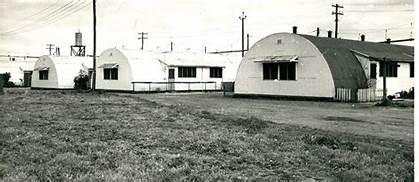
The long rows of nissan huts and the toilet and shower blocks in between were a study in conformity. So similar were they that on one occasion my younger brother exited the toilets from the wrong door and, entering what he thought was our unit, proceeded to nap in someone else’s lodgings!
The uniformity seemed to suit our circumstances. Here we were, a young family in a new land surrounded by other young families. All recent arrivals and all ‘New Australians’ in a land that is forever new and forever old.
We were English, Irish, Scots, French, Polish, Italian, Yugoslav and a scattering of other nationalities. England, in the time of my childhood, was pretty much a homogeneous mono-culture. Yet here we were in this marvellous melting pot of language and culture that would colour the rest of our lives in this new land.
Though we ‘New Australians” came from different countries and cultures and, while many spoke different languages, we held something else in common that speaks clearly to me now about our parent’s generation of immigrants. All had experienced the ravages and deprivations of the War in Europe. Taking on the monumental challenges of immigrating was perhaps less difficult by comparison with the trials of their own youth. This was a tough generation, determined to succeed and determined to find new and better lives for their own.
Mum was a child of a farm manager in Jersey, Channel Islands. The Channel Islands were the only British territory occupied by the Nazis. Though their overlords were decent enough to the islanders, for the most part, food was scarce and life was very uncertain and potentially short.
Dad was a lad in Belfast during the war. Only recently has he described to me hearing the sound of the Nazi bombers heading to drop their deadly payload on the Belfast docks and shipyards. He would ‘head for the hills’ with his uncle to observe the carnage from a safe distance.
And to school we went. The little Catholic School of Mt Carmel, run by the Josephite Sisters, was as multicultural as one could imagine. Language issues must have been a constant for teachers then, but I can’t recall there ever being any real problem. It was just the way it was; none of us really knew any different. The ‘newness’ of life as a child discovering the world meant that everything about this cultural tapestry was our normal.
We lived at the Migrant Centre for about six months as I recall. After a short time renting in an adjacent suburb, Mum and Dad bought a home not far from the Migrant Centre itself and our schooling courtesy of the good sisters resumed.
Mum’s family were both Breton and Norman. Her childhood French was put to good use assisting French speaking immigrants in those years to find their feet as we had done.
If our home was not alive with the sound of French conversation, it was English with strong English, Irish or Scottish accents. Fuelled by liquid courage, all of Mum and Dad’s friends had a song to be sung or a poem to be recited. The songs were always either tragedies of lost love or songs of rebellion and hope. We learnt much of our heritage from listening and joining in.
Friends made in those early days whose experience of life we shared in so many ways, became friends for life. Though our blood relatives were a long way away, we became as surrogate extended families, each for the other.
Many of Dad’s work mates on the wharves at Port Adelaide were ‘New Australians’ too. There was plenty of work in the Port in those days and, if it were not enough of a cultural melting pot already, visiting sailors were often Filipinos or Middle Eastern in origin.
Our schooling remained as part of the Catholic School system throughout both primary and secondary. There were certainly less numbers of immigrants in the student body at high school. I imagine that many who arrived here at about the same time as us chose the public system.
Thinking of those days and using today’s language, casual discrimination occurred reasonably frequently. It was not so much about creating or tolerating offence in those days and more about tribal identification; the need to belong; to identify with one group by focusing on those who did not belong to that circle. I can’t recall it ever being anything other than casual; just the way it was.
‘Sheilas, wogs and poofters’ was the title of Australian Soccer legend, Johnny Warren’s autobiography. The connection between such epithets and soccer will be well understood by mine and earlier generations of immigrants. I was drawn to soccer essentially because my Father had played the game in Ireland and England. It wasn’t that I disliked Aussie Rules, I just didn’t understand it. To choose soccer over footy was, perhaps a little rebellious, but I felt at home on the rectangle field.
My high school saw it differently. The priority was Aussie Rules and every student was to try out for the teams and, if unsuitable, maybe then they could play another, lesser, sport. I would have none of it. Avoiding confrontation I simply joined in with the ‘Sheilas, Wogs and Poofters’ and added basketball to my skill set as well.
That our school’s priority was for football was partly a matter of tradition and pride. We were a good Aussie Rules school and the team that came from my year was undefeated right through. A reflection of that priority could be seen in the attention given to the various playing surfaces. The footy/cricket ovals were pristine; the soccer pitch looked like a reclaimed dump. Still, we played on and we did quite well.
My team mates were Italian, Greek, Polish and Maltese as I recall. I was the only Brit. They were mostly second generation Aussies.
This was a pattern I saw repeated years later when I resumed playing soccer as an adult. The teams in and around the city were largely identified with non-English speaking European countries while the English, Scots and Irish based teams were situated north and south of the city in the newer residential developments. This followed the patterns of immigration as it did the creation of the satellite city of Elizabeth to the north.
Playing soccer for a Yugoslav team was a joy. I learned a little of the language. Of course, the most frequently heard words were the easiest to remember. I never did find out what they meant, but yelling them on the field of play brought laughter from our supporters. No doubt I was spouting colourful language, the kind not heard in Church!
Some years later the Soccer governing bodies eschewed the use of ethnic based club names. I was never sure whether this was a good move. Identity is important. Perhaps they had noted that the various clubs playing lists and supporter bases were becoming more integrated and varied so as to render the old names redundant.
But all things old are new again – even in sport. New patterns of immigration in recent decades has seen the development of soccer clubs of Middle-Eastern and African identity. Just as in my day and in the generation before, these clubs provide a great social good. The powers that be seem to have recognised this and many older clubs are now resuming use of their old names.
It has been a joy for me these past years to see my son, John, develop into a fine soccer player. Again history repeats itself! For the previous two seasons John was the only Caucasian in his club made up largely of Afghani and African players. And, yes, he learnt a few words in Farsi. I hope they were less caustic than those I spouted with abandon in my day. I am sure they were. Here we see another wave of immigrants making new lives. As with earlier generations, their contribution to this nation will be considerable and a long-lasting good.
Which draws me back to home. Not England nor the home of my childhood but the home my wife and I have shared with our children for more than 30 years. The inner-northeast of Adelaide at Klemzig was first settled by German-speaking Prussians. Refugees from religious persecution, they made a little settlement very close to where we now live. Many moved on from here to the Barossa Valley and other regions in the hills beyond Adelaide. The small plot of land that marks their coming and the lives of those buried at their first cemetery is a street away from me. The names enshrined there are a roll-call of surnames that had great influence over the development of South Australia. They were vignerons, captains of industry, religious leaders, politicians, artisans etc. Their efforts are rightly recognised in many ways and in many places and their influence still exists today.
I’d like to think that all of the waves of immigrants that made their homes in Australia also made their mark. In fact, I’m sure of it. Each has brought something new to this new land. All hold memories of their home and the reasons they left and the love of those left behind. Times have changed, certainly, but one thing Solomon was right about was that people don’t. Humanity remains as potentially resilient, courageous and compassionate as ever given the right circumstances and opportunity.
We were given that opportunity. An opportunity that formed us and the waves of those who came before and since who continue to make this nation new and full of opportunity. For that I remain thankful, always.
Written as an entry in a competition at sbs.com.au

 Paul Russell: Musings