
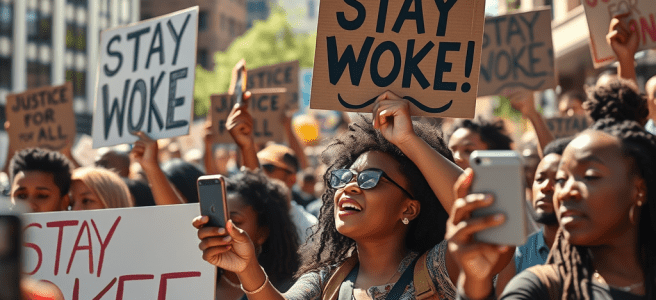
I was surprised to find that the term ‘Woke’ is not of recent origin (though upon reflection, I should not have been so).
Its earliest usage can be traced back to the mid-1930s in the American Black Community as a call to stay alert to race-based violence. In the 1960s it was taken up by the Civil Rights Movement and its meaning was amplified to include both social and political awareness.
Most people – particularly non-American people like myself – will recall its use as contemporaneous with the BlackLivesMatter Movement following the deaths of Trayvon Martin (2012) and Michael Brown (2014); the latter being the catalyst for mass, spontaneous protests and riots in Ferguson, Missouri.
The rioting and mayhem resurfaced once more in May 2020 at the death of George Floyd. At that time #BlackLivesMatter gained international prominence with demonstrations across the globe, including in major capital cities here in Australia. ‘Stay Woke!’ became a rallying cry for racial justice and Police reform.
I wrote ‘rioting and mayhem’ deliberately as recognition that the raw energy and expressions of anger and injustice did, in part at least, create social unrest and damage to public and private property. That can never be justified; though perhaps we can show empathy towards those involved and at least try to understand.
Thereafter, the idea of ‘woke’ and the understanding of what it signified, expanded. Some within the original ‘woke movement’ saw it as a dilution of their aims and objectives. Others saw it as taking up ‘woke’ as an example of a standard and approach that could be well applied to other areas of social justice. Not everyone saw it in those terms.
While ‘progressives’ applied it to gender, LGBTQ+ rights, climate justice, immigration, and DEI (Diversity, Equity, and Inclusion), ‘conservatives’ used ‘woke’ as a pejorative; coining phrases such as “woke capitalism”, “woke indoctrination”, “anti-woke” laws and slogans such as ‘go woke – go broke’.
The adoption of what came to be known as the phrase ‘Cancel Culture’ – a cousin to the ‘woke movement’ surfaced in about 2018 with the #MeToo movement and backlash after the allegations of sexual assault levelled against Hollywood Producer Harvey Weinstein. Of interest, the success of #MeToo and Cancel Culture generally can be attributed, in part, to the expansion of social media.
While #MeToo allowed people who had suffered abuse at the hands of Weinstein and others to speak publicly about their experiences, Cancel Culture had very little that I find at all redemptive. (ProCon at Britannica does list some ‘pros and cons’.)
Pope Francis said of Cancel Culture that it is, “a form of ideological colonization, one that leaves no room for freedom of expression”, adding that it “ends up cancelling all sense of identity”.
The co-founder of Black Lives Matter, Patrisse Khan-Cullors, observed that “People don’t understand that [social activist] organizing isn’t going online and cussing people out or going to a protest and calling something out.”
‘Cancelling’ someone can express anger, distaste, or injustice with some sort of immediate gratification, but it is a poor substitute for putting in the kind of descent effort that any righteous form of indignance probably demands.
President Trump made the following observations in a speech on the 4th of July 2020:
“Angry mobs are trying to tear down statues of our Founders, deface our most sacred memorials, and unleash a wave of violent crime in our cities. Many of these people have no idea why they are doing this, but some know exactly what they are doing. They think the American people are weak and soft and submissive. But no, the American people are strong and proud, and they will not allow our country, and all of its values, history, and culture, to be taken from them.
“One of their political weapons is “Cancel Culture” — driving people from their jobs, shaming dissenters, and demanding total submission from anyone who disagrees. This is the very definition of totalitarianism, and it is completely alien to our culture and our values, and it has absolutely no place in the United States of America.” (Yes, the irony is not lost on me at this moment in time!)
So, what to make of it all?
I well recall in my youth the protests and the issues that grasped the attention of my cohort – particularly (and appropriately) those at university. Anti-Apartheid, the Vietnam War, and anti-Nuclear armaments among them. These were important issues. Just as important, I would argue, that young people finding their place in the world should develop a sense of justice and outrage at incursions against justice and express them.
In many respects, I find at the root of ‘Woke’ a desire for the same sort of expression. This post-modern world has been denuded of much of the certainties in terms of boundaries and moral and social norms and absolutes. ‘Woke’ in that context, in my opinion, is a search for such boundaries and is, therefore, a good thing at its core.
That ‘Woke’ has found expression sometimes in violence and destruction is regrettable, but not surprising. That some rail against ‘Woke’ isn’t at all surprising either. But its expression, I believe, should be actively disassociated from those whose actions discredit it and whose actions, therefore, tend to obscure what, at its core, could be considered a good thing. It’s important to ask: why?
An opportunity to foster a generation that is searching for truth, certainty and justice was, I believe, a moment largely and sadly missed.
I was fortunate, at the time of #BlackLivesMatter to have an association with Aboriginal elders through my role as an elected member of my local council. Port Adelaide Enfield has had an Aboriginal Advisory Panel for over 20 years catering for the aspirations of our Aboriginal residents.
Why Aboriginal people in Australia protested widely at that time was of personal interest to me. Sure, there’s something to be said for solidarity; but this was much more than that. It was visceral. Clearly, it triggered memories of old and recent wounds, of mistreatment, of institutional and individual racism. In essence, it was for a very large part the same kind of ‘enough is enough’ that was being expressed by African Americans. Being and staying ‘woke’ (without necessarily invoking that word), in other words, being watchful and alert, seemed to me to be a necessity.
Our ‘woke’ council grappled with these issues alongside Aboriginal Elders and, to our great credit, we were able to come up with practical and, I believe, life-changing initiatives that will resonate for generations and bring reconciliation, healing and hope. We asked the ‘why’ question, grappled with it and came up with solutions. A model for human engagement and ‘woke’ properly applied and understood.
And that’s why, in these few words, I’m suggesting that we all need to stay ‘woke’. If you have an aversion to what, after all, is really a non-word, then simply stay alert and informed.
Our world is changing right now at an alarming rate. We have easier access to information now and a greater abundance of content than at any time in human history. Our ability to become and remain informed is such that access is not a problem.
What may be at issue is our own inherent biases. I don’t state that in a negative way; we all have biases in one way or another.
The question I ask is not whether or not any particular bias is good or bad; right or wrong. My interest is how informed are those positions. Do we instinctively ask ‘why’ so as to understand or do we allow our biases to dictate our responses?
I am not suggesting that our biases will always lead us to the wrong conclusion or interpretation. I’m not suggesting that every time we do ask ‘why’ we will change our view.
What I am saying, from my own observations, is that we progress as persons and as societies if we take the time to flip the coin over to look at the other side. In politics in my country and particularly in the USA, this has not been the case. Our media and some of the political classes have encouraged us to see the term ‘woke’ as a catch-all for all types of behaviours and programs that need rooting out. We are not encouraged to take the time to discern what is considered ‘woke’ and what is not. Empowering such broad statements is to invite excess akin, perhaps, to witch burnings.
We seem to be overloaded with major international hot spots and issues that pop up and assault our senses daily. It is easy to be overwhelmed. It is easy to accept what we see and hear on our news services and socials and to either glaze over from the enormity of it all or simply accept that what one source says is the truth.
We all know that different media outlets have differing editorial objectives and viewpoints which slant reporting. Social media is no different. All I’m suggesting is that we ask the question ‘why’ in an effort to understand.
This might mean simply reading the whole article or listening to the whole podcast rather than just the headline. It might mean seeking a different source of information to try to gain a broader perspective. Use your search engines and ChatGPT. It only takes a moment.
How will this help? Informing ourselves is about personal growth. Even in advanced age (like me) exercising the grey matter is a good end in itself. Developing a default position to ask ‘why’ also helps us develop empathy, not only for the issues we seek to understand but also towards those that we know who hold a different view.
Maybe you and I can’t solve the problems. But just maybe, by increasing our understanding as an opportunity for empathy and tolerance, we can make our corner of this world a better place.

 Paul Russell: Musings