
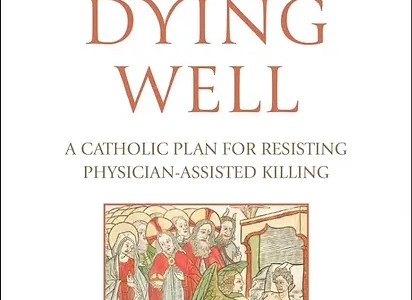
Living and Dying Well – Charles Camosy
Published by OSV (2025) Pp 183
Available at www.charlescamosy.com/books/living-and-dying-well
Charles Camosy teaches moral theology and bioethics at the Catholic University of America
Charles Camosy first came to my attention some years ago when he was listed as a guest speaker at a conference in Queensland, Australia auspiced by the QUT’s Australian Centre for Health Law Research. Charles debated Peter Singer on that occasion.
He struck me then as a serious individual with a great capacity for compassion and empathy. Living and Dying Well re-enforced that view.
I was attracted, at first blush, to this work by the sub-title: A Catholic Plan for Resisting Physician- Assisted Killing. I worked full-time at opposing euthanasia and assisted suicide in Australia for many years and remain vitally interested in the subject. Having a ‘plan for resisting’ was my bread and butter. However, as I found out, activism – in the sense of political action – was not Camosy’s intention.
No, his book is far more profound than simply a guide or ‘how-to’ tome on social and political activism.
It is, as he argues, a form of resistance to the cultural drift to model dying well by deliberately and intentionally living well. Actively living well requires a knowledge, acceptance and awareness of our mortality. It grounds us actively in the present while cultivating a healthy attitude to our ultimate demise and to that of others.
As an important point of reference, Camosy lays before us at the beginning a brief look at the status of assisted suicide and euthanasia across the globe, the known reasons that people seek their end in that manner, and clarifies why many consider our modern culture to be a ‘eugenic culture’; or what Pope Francis termed a ‘throwaway culture’.
The larger and central chapters of the book are devoted to providing examples of living and dying well from the lives of the saints, from the lives of Catholic monks and friars and, through exemplars in the works of care homes and in hospice care. These chapters provided me with an opportunity for deep reflection and inspiration.
The remaining chapters offer sound advice to individuals, families, communities and institutions on resisting assisted suicide through deliberate choices to live well and to help others live and die well.
In the final analysis, as I have experienced in political action, it may well be impossible in an individualistic culture, to resist the zeitgeist ad infinitum. Resist as we might (and we most definitely should), there will be times when legislatures overturn statutes in favour of medicalised and deliberate death. What if the legislatures are resisting? How do we seek to improve the status of good end-of-life care and improve society’s appreciation of what it looks like to die well to bolster that resistance?
In both situations, we need to take on the challenge of living counter to the culture and the cultural drift. Camosy, in his debate with Peter Singer (mentioned above) used the term ‘structural coercion’, by which I take to mean the effect a prevailing culture has on the attitudes and reasoning of individuals, societies and institutions. Such things affect us all whether we are aware of it or no.
Whether living counter to the culture ultimately changes that culture or not is difficult to predict. It has happened before. Consider the long and torturous path to the abolition of slavery. However, the ‘ends’ we need to consider are intrinsically linked to the fact, as the Church teaches, that each human person is indeed an end in themselves. We may hope that by adopting a radical approach to living and dying well that society may change for the better; but that’s not a given.
Camosy offers three valuable appendices to his work. In Principles and Prayers, he offers a succinct guide to understanding humanity from an authentically Catholic perspective and completes the section with a list of traditional prayers. Practical Guidance contains some references that are particular to the US, however, it remains applicable generally and is full of common sense. Responses to FAQs is particularly useful as Camosy answers some of the more commonly heard questions about euthanasia and assisted suicide.
The book is a valuable contribution on death and dying.

 Paul Russell: Musings